\n Defense & National Security\n

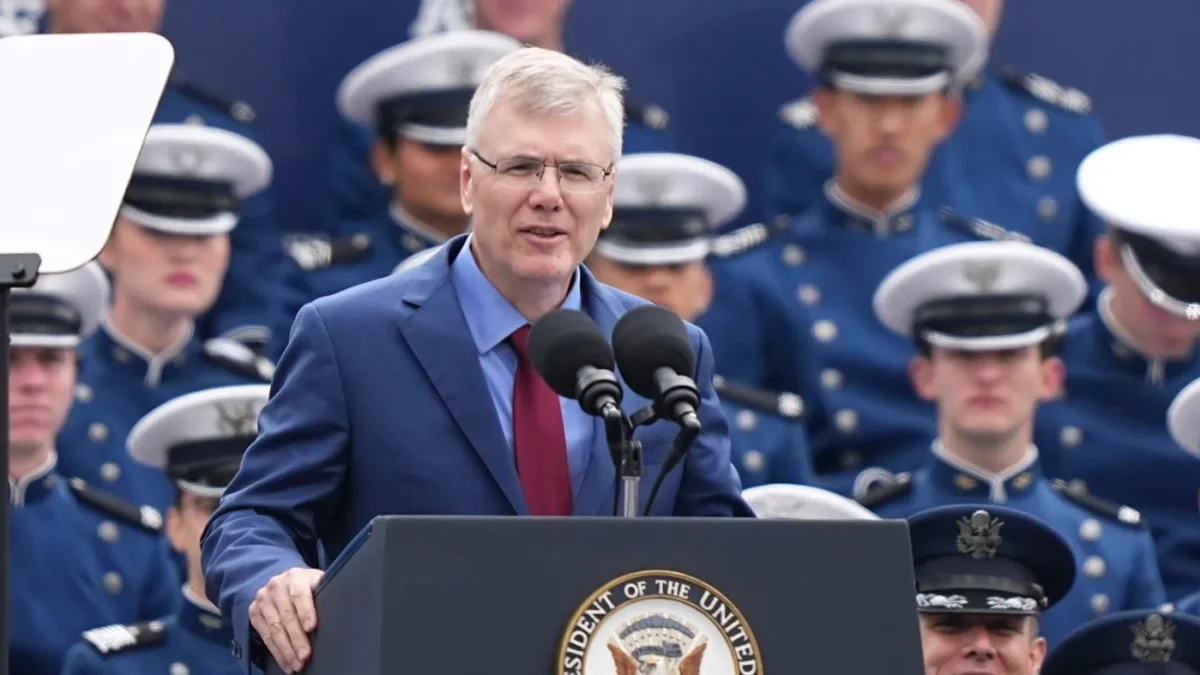
Table of Contents
U.S. Air Force Secretary Confirms Military Weapon Has Been Placed in Orbit
Provpnadvice.com – The United States has acknowledged for the first time that it has positioned a military weapon in space, a development that underscores mounting competition among major powers beyond Earth’s atmosphere.
Air Force Secretary Troy Meink confirmed the capability Monday during the annual Air, Space and Cyber Conference in National Harbor, Maryland. While he did not identify the system, describe its technical functions, or say when it entered orbit, Meink said it is intended to give the United States the ability to respond if its forces face threats in space.
“We are increasing readiness against existing threats and the United States has on-orbit space control weapons capable of defending the Joint Force against hostile adversary action,” Meink said.
The confirmation is significant because American officials have previously discussed the need to protect satellites and space-based military infrastructure, but had not publicly stated that the United States had deployed an on-orbit weapon. Satellites play an essential role in modern military operations, supporting communications, navigation, intelligence gathering, early warning and coordination among forces around the world.
Meink did not indicate whether the weapon is designed to disable, deter or otherwise counter hostile systems. He also did not say how many such weapons may be in orbit. His comments nevertheless place the United States more openly within an increasingly tense debate over whether space is becoming another arena for military confrontation.
“Make sure that when we’re threatened, we can take care of that,” Meink said of the capability.
China and Russia criticize the move
China issued a sharp response Tuesday, arguing that military deployments in orbit risk turning space into a zone of conflict. Beijing called for space to remain safe and available for peaceful activity while opposing what it described as efforts to fuel an arms race beyond the atmosphere.
“China stands for peaceful use of the outer space and keeping it safe, and opposes any arms race in outer space or any attempt to weaponize it and turn it into a warzone,” China’s Foreign Affairs Ministry said.
The ministry urged Washington to end its military expansion in outer space and to support global strategic stability through concrete measures.
Russia also objected to the acknowledged U.S. capability. Kremlin spokesman Dmitry Peskov said Moscow’s position is that weapons should not be placed in space, and he called for international cooperation toward removing military weaponry from orbit.
“We are counting on broad international consolidation to continue working toward the complete demilitarization of space,” Peskov said.
The reactions reflect a long-running disagreement among major powers. Nations have relied on satellites for decades, including systems used for civilian commerce, scientific research and national security. Yet the growth of military dependence on space assets has created pressure to protect those systems from interference, attack or destruction.
Growing focus on threats to satellites
Meink pushed back when asked whether criticism from China and Russia should influence the American position. He pointed to concern in Washington that both countries have pursued their own capabilities that could threaten spacecraft or military operations in orbit.
“Is there any question . . . about whether or not the Chinese or Russians have been developing these sorts of weapons,” Meink told reporters.
His remarks frame the U.S. deployment as a defensive measure tied to the protection of the Joint Force. In military terms, “space control” generally refers to the ability to preserve access to space for friendly forces while limiting an adversary’s ability to use it against them. The concept can include defensive steps to safeguard satellites as well as capabilities intended to deter hostile action.
That distinction is central to the diplomatic dispute. U.S. officials can present an on-orbit system as necessary to defend space infrastructure, while China and Russia can argue that placing weapons in orbit increases the likelihood of escalation. Without public details about the weapon, its mission and its operating limits, outside observers have little basis for assessing how it may affect the balance of power in space.
Why the announcement matters
Military planners increasingly view space as indispensable to operations on land, at sea and in the air. A disruption of satellite communications or positioning services could complicate the movement of forces, intelligence sharing and command decisions. Early-warning satellites can also contribute to the detection of missile activity.
The public acknowledgment by the Air Force secretary therefore signals that Washington sees orbital security as more than a theoretical concern. It also raises questions about the rules that should govern military conduct in space, including how nations communicate during a crisis and how they prevent an attack on one satellite from triggering a wider confrontation.
For now, the United States has provided few details beyond Meink’s assertion that on-orbit weapons are available to defend against hostile action. China and Russia have made clear that they view the disclosure as evidence of a dangerous shift. The competing statements show how rapidly space security has moved from a specialized policy issue to a more visible element of great-power rivalry.
Related Reading
Frequently Asked Questions
What is n Defense National Security n?
n Defense National Security n is the main topic of this guide. The article explains the context, practical details, and next steps readers should understand.
Why does n Defense National Security n matter?
n Defense National Security n matters because readers are looking for a useful answer, not just a short summary. Good content should match search intent and help them decide what to do next.