Jackson rebukes Thomas over his birthright citizenship dissent

Supreme Court Clash Over Birthright Citizenship Interpretation
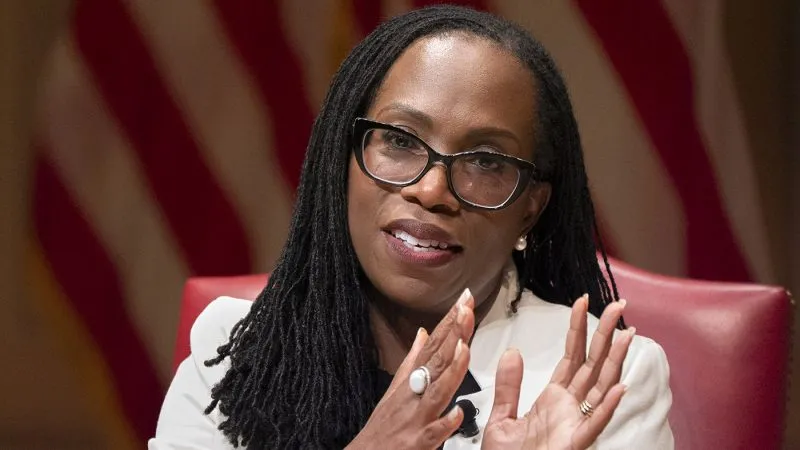
Provpnadvice.com – On Tuesday, Supreme Court Justice Ketanji Brown Jackson publicly criticized Justice Clarence Thomas for his dissent in the court’s ruling that upheld birthright citizenship, a foundational principle of American law. The disagreement, which emerged during a contentious debate over the 14th Amendment, highlighted a stark ideological divide among the justices. Jackson’s rebuke centered on Thomas’s argument that the Citizenship Clause of the amendment was originally intended to grant citizenship to freed slaves, a perspective she deemed overly narrow and historically inaccurate.
Concurring Opinion Challenges Thomas’s Historical Framework
In a 20-page concurring opinion, Jackson took issue with Thomas’s interpretation of the 14th Amendment, asserting that his view of the clause as a “race-conscious remedial measure” failed to capture its broader purpose. She pointed out the inconsistency in Thomas’s stance, given his prior advocacy for a “colorblind” Constitution. Jackson emphasized that the amendment was designed to redefine citizenship for all individuals born in the United States, regardless of their racial background, and that Thomas’s dissent seemed to contradict this long-standing principle.
“Despite his longstanding endorsement of a ‘colorblind’ Constitution, Justice Thomas now surprisingly suggests that the Citizenship Clause was a race-conscious remedial measure, relating only to ‘freed slaves such as Dred Scott,’” Jackson wrote.
Thomas, joined in the minority by justices Samuel Alito and Neil Gorsuch, contended that the 14th Amendment’s language was limited to those “domiciled” in the United States at the time of its ratification. His dissent argued that the clause was specifically crafted to address the status of formerly enslaved individuals, a claim he tied to the Supreme Court’s infamous 1857 decision in Dred Scott v. Sandford. Thomas maintained that the court had misapplied the amendment, stating that enslaved African Americans were entitled to citizenship as Americans.
“They had no other homeland, owed no allegiance to any foreign power, and were subject to no other authority,” the longest-tenured member of the court wrote.
Thomas’s reasoning extended to contrasting the experiences of freed slaves with those of foreign visitors. He claimed that temporary immigrants, unlike African Americans during Reconstruction, were not fully integrated into American society and would not be obligated to serve in times of war. This distinction, he argued, underscored the amendment’s intent to grant citizenship to individuals with a stronger connection to the United States, as opposed to those with foreign ties.
Majority Opinion Defends Birthright Citizenship
Meanwhile, the majority of justices, including Chief Justice John Roberts, Sonia Sotomayor, Elena Kagan, and Amy Coney Barrett, upheld the principle that birthright citizenship applies to all individuals born on U.S. soil, even those whose parents are undocumented. This decision invalidated President Trump’s executive order, which required at least one parent to be a citizen or hold legal permanent status for a child to automatically gain citizenship. The ruling reinforced the idea that the 14th Amendment’s protections are universal and not restricted by the immigration status of a child’s parents.
Brett Kavanaugh, also part of the majority, diverged from the five justices in his reasoning. While agreeing with the outcome, he argued that the president’s order did not violate the 14th Amendment but rather aligned with its language under the Nationality Act of 1940. Kavanaugh’s position introduced a nuanced debate about the amendment’s original intent versus its modern application, further complicating the legal discourse.
Thomas’s Dissent and Jackson’s Counterarguments
Jackson, who partially joined Sotomayor’s opinion, consistently challenged Thomas’s interpretation of the amendment. In one particularly pointed critique, she labeled his analysis as “myopic,” suggesting it overlooked the broader historical context of the Reconstruction era. Jackson clarified that freed slaves did not receive a new status through the 14th Amendment but were recognized as U.S. citizens because of their birthplace, not their race.
“Justice Thomas’s telling elides the entire point of the Second Founding: The Reconstruction Amendments were an anticaste, antisubordination reset for the Nation, not a mere spot treatment for the dark stain of slavery,” the most recent addition to the court wrote.
Jackson’s argument underscored the transformative nature of the 14th Amendment, which was intended to dismantle the vestiges of slavery and establish a more inclusive definition of citizenship. She emphasized that the amendment’s language—“All persons born or naturalized in the United States, and subject to the jurisdiction thereof, are citizens of the United States”—was meant to apply broadly to anyone born in the country, irrespective of their parents’ legal status. This interpretation, Jackson contended, was essential for preserving the constitutional promise of equality.
Thomas’s reliance on the Dred Scott decision reflected his broader judicial philosophy, which often emphasizes originalism and textualism. By invoking that landmark case, he sought to frame the current debate in terms of historical clarity, arguing that the amendment’s creators would have understood it to apply only to individuals with a clear connection to the United States. However, Jackson countered that the historical context of the amendment’s passage in 1868 was rooted in the need to secure citizenship for newly emancipated people, regardless of their race or social status.
Broader Implications for Immigration Policy
The ruling has significant implications for immigration policy, particularly in debates over the rights of children born to undocumented immigrants. By affirming birthright citizenship, the court rejected the notion that the 14th Amendment could be used to exclude such individuals from the rights of American citizenship. This decision has sparked discussions about the role of the judiciary in shaping immigration law and the potential for future challenges to similar principles.
Thomas’s dissent, while not altering the court’s outcome, has nonetheless ignited a deeper conversation about the amendment’s interpretation. His argument that the clause was a race-specific remedy has drawn both support and criticism from legal scholars and justices alike. Jackson’s rebuke serves as a reminder of the evolving nature of constitutional law and the importance of contextual understanding in legal reasoning. As the court continues to grapple with questions of citizenship and equality, the exchange between Jackson and Thomas highlights the complexity of balancing historical intent with contemporary applications of the law.
In sum, the dissent and concurring opinion reveal a pivotal moment in the Supreme Court’s history, where the interpretation of a centuries-old amendment is being reevaluated in light of modern challenges. The debate underscores the ongoing struggle to define what it means to be an American citizen and the diverse perspectives that shape this fundamental legal principle.