5 things to know about the ‘Great American State Fair’

5 things to know about the ‘Great American State Fair’
Provpnadvice.com – The Great American State Fair is set to unveil to the public on Thursday morning with a grand ceremony, coinciding with ongoing political tensions and public disputes surrounding the festivities commemorating the nation’s 250th anniversary. The event, which will span 16 days, aims to blend celebration with historical reflection, though its political undertones have sparked debate among observers.
A Grand Display of American Heritage
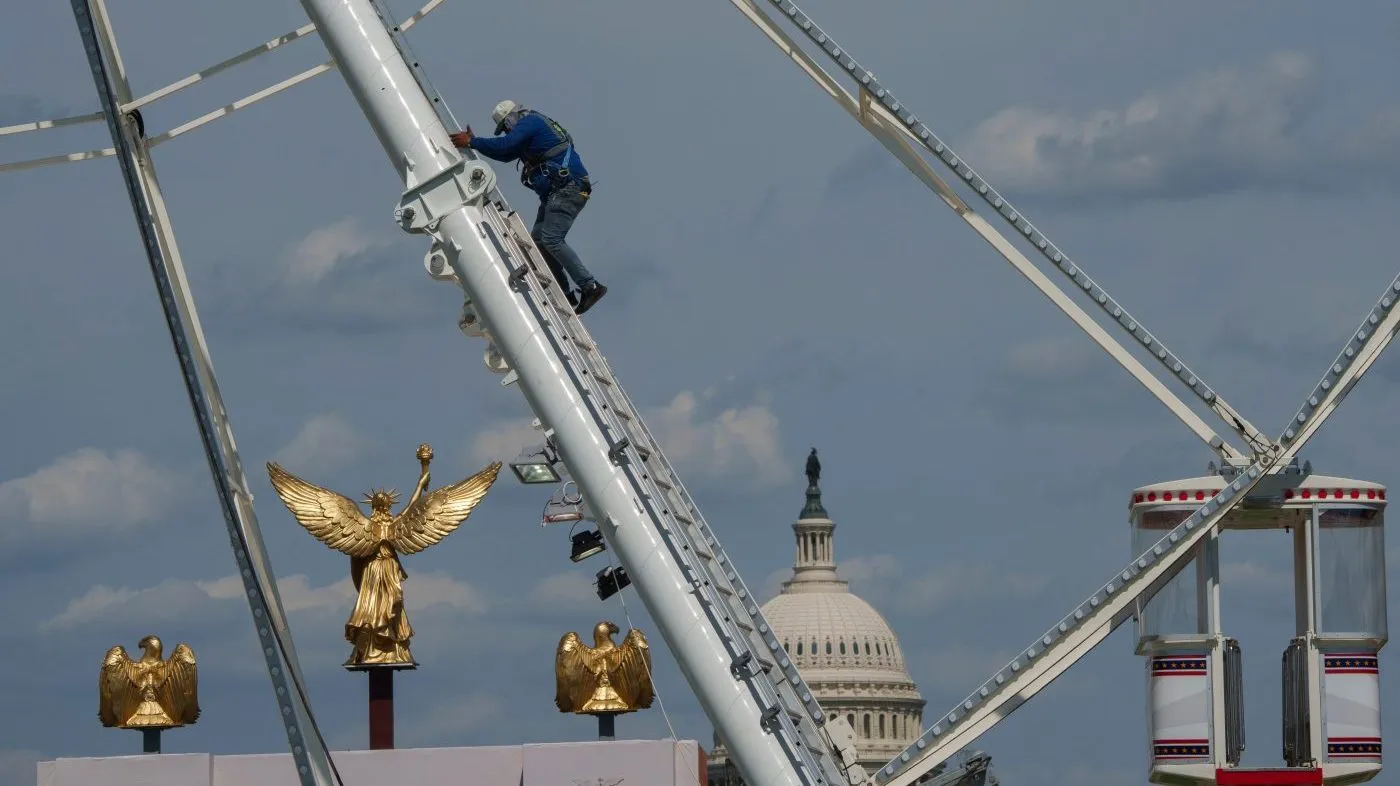
Arranged across the National Mall in Washington, D.C., the fair features an array of white booths adorned with flags representing every U.S. state, territory, and federal agency. This vibrant setup, visible on Wednesday afternoon, sets the stage for the event’s opening. Alongside the booths, a towering Ferris wheel and a miniature replica of President Trump’s proposed Triumphal Arch are positioned directly in front of the Washington Monument, creating a striking visual centerpiece.
“Rodeo 250 is more than a western showcase; it’s a celebration of the values and traditions that helped build our nation,” said Keith Krach, chief executive of Freedom 250, in a statement released earlier this month.
The fair’s venue, the American Heartland Arena, will serve as a hub for interactive experiences, including performances of traditional Western arts, live trick roping demonstrations, and simulated cattle drives. These activities are intended to immerse visitors in the cultural fabric of American life, with a focus on the country’s historical roots and contemporary identity.
A Thematic Journey Through Time
Each day of the fair will revolve around a distinct theme, designed to illuminate different facets of American tradition while casting a forward-looking gaze at the nation’s next 250 years. Themes such as “Military Appreciation Day” and “Family Life” are expected to resonate with diverse audiences, offering a multifaceted narrative of the United States’ past and future.
The first week of the event will highlight the “Make America Healthy Again” (MAHA) movement, backed by Health and Human Services Secretary Robert F. Kennedy Jr. These “MAHA Mondays” are intended to foster dialogue on health innovation and wellness, aligning with the broader goals of the fair. Other notable themes include honoring veterans and service members, as well as celebrating faith, values, and inspirational narratives that define American society.
Partisan Tensions and Political Participation
Despite its mission to promote unity, the fair has drawn criticism from Democratic state leaders and legislators, who argue that its events have increasingly leaned toward partisan alignment. This concern is particularly evident in the president’s involvement, which has been a focal point for detractors.
President Trump will not only deliver a keynote address at the fair’s launch but also participate in additional events. These include a grand opening ceremony for former President Theodore Roosevelt’s library next month and a rally preceding the Independence Day fireworks on the National Mall. His anticipation for these appearances was evident in a recent post on Truth Social, where he described the fair as a “Big Rally on the National Mall. Fantastic Music!!! MAGA!!! FUN!!!”
Artists and Controversies
The fair’s lineup of performers has faced some shifts, with several artists withdrawing due to backlash over its perceived political direction. In response, Trump positioned himself as the event’s top attraction, emphasizing his role as a key figure in its success. While his speech remains a central event, a range of smaller artists will still contribute to the cultural offerings, including FBI Director Kash Patel’s girlfriend, country singer Alexis Wilkins.
Freedom 250, the organization behind the fair, has consistently maintained that the celebrations are nonpartisan and inclusive. However, seven Democrat-led states have opted out of the event, citing concerns about its political branding. Despite this, the organization asserts that all 50 states and six U.S. territories will be represented through partnerships with local entities, ensuring nationwide participation.
Air Traffic Adjustments
The fair’s airshow elements are anticipated to significantly affect flight operations at Ronald Reagan Washington National Airport (DCA). Starting with the opening festivities on Wednesday and Thursday, military flyovers will occupy the airspace above the National Mall, requiring temporary adjustments to air traffic routes. Additional disruptions are expected during the “Military Appreciation Day” on June 28, Independence Day rehearsals and celebrations on July 3 and 4, and the closing ceremony flyover on July 10.
Freedom 250 has announced a variety of aerial attractions, including the U.S. Air Force’s F-16 Viper Demo Team, B-2 Spirit Stealth Bomber, F-35 Lightning II, and F-15 Eagle. These displays will create a dynamic backdrop for the fair’s events, drawing both local and international attention. In response to the anticipated disruptions, several airlines have already revised their schedules, though the Metropolitan Washington Airports Authority warns that temporary delays may still occur.
Legacy and Vision
Freedom 250 has framed the fair as a “living historical experience,” emphasizing its role in connecting visitors with the nation’s past while inspiring its future. The organization aims to create a platform where American traditions and aspirations coexist, fostering a sense of collective pride and shared purpose.
As the event approaches, its organizers are working to balance the celebration of historical milestones with contemporary issues, such as health policy and national unity. Whether viewed as a cultural landmark or a political spectacle, the Great American State Fair is poised to make a lasting impression, offering a unique opportunity to reflect on the United States’ journey and its next chapter.