Jeffries: ‘I don’t support’ DSA agenda

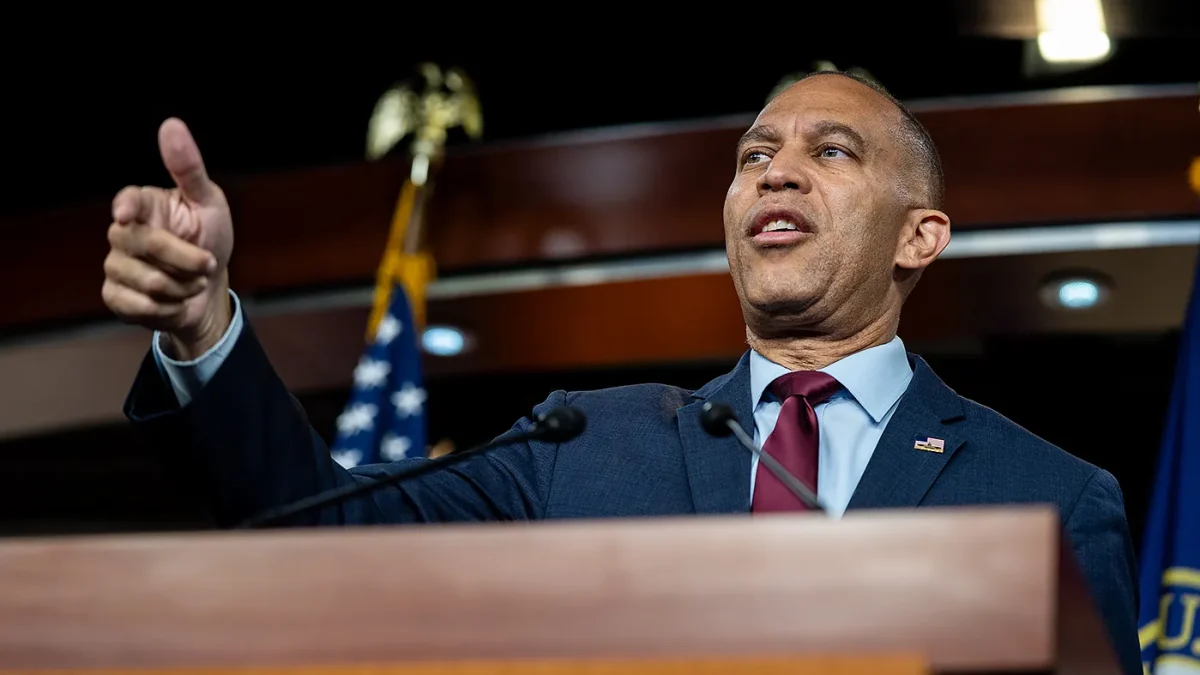
Table of Contents
Jeffries Draws a Line Between Democratic Socialism and House Leadership Ahead of Midterms
Provpnadvice.com – With the November general elections approaching and Democrats polling favorably against a Republican White House rattled by foreign-policy turbulence and economic anxiety, House Minority Leader Hakeem Jeffries (D-N.Y.) moved Sunday to clarify where his office sits relative to the most energetic faction currently reshaping the party’s left flank. Speaking on NBC News’s “Meet the Press,” Jeffries made clear that he does not endorse the program articulated by the Democratic Socialists of America, even as candidates aligned with democratic socialist or insurgent progressive platforms have swept a string of primary contests over the past several months.
A Broad Caucus, Not a Single Ideology
Jeffries framed his position not as a rejection of progressive values per se, but as a recognition that the House Democratic Caucus will be ideologically heterogeneous once the November results are tallied. He acknowledged that members elected through Democratic primaries — some of whom carry explicit democratic socialist credentials — will join the caucus alongside centrists and traditional liberals.
“I don’t support the DSA agenda, as has been articulated by the DSA itself. Now, you’re going to have individual members who have been elected in Democratic primaries and if they are elected in the general in November, will be part of the House Democratic Caucus. It’s going to be a broad caucus. There will be progressives. There will be New Dems. There will be Blue Dogs,” Jeffries told Kristen Welker on “Meet the Press.”
The remark lands at a moment when the party’s internal map is shifting faster than its institutional leadership has historically preferred. Over the last election cycle, candidates who ran on platforms emphasizing collective ownership of major industries, universal public services, and workplace democracy have unseated long-tenured establishment figures in statehouses and congressional districts across the country. Jeffries’ comments signal that he intends to manage that diversity from the top rather than absorb a single ideological line into his leadership brand.
The DSA’s Organizational Role
The Democratic Socialists of America operates as a nonprofit activist organization and functions as the principal institutional infrastructure for democratic socialism in the United States. Its membership rolls, local chapters, and policy papers give it a reach that individual candidates rarely match on their own. Yet Jeffries’ phrasing — “as has been articulated by the DSA itself” — draws a deliberate distinction between the organization’s formal platform and the broader current of democratic socialist thought that may animate a legislator without requiring formal membership.
On its own website, the DSA defines democratic socialism as
“a system where ordinary people have a real voice in our workplaces, neighborhoods, and society”
and calls for collective ownership of what it terms “key economic drivers that dominate our lives” — language that points toward sectors such as energy, telecommunications, pharmaceuticals, and financial services. That framing sits at the outer edge of mainstream Democratic policy and explains why a party leader would want to distance his office from the organization’s most ambitious proposals while still courting voters who gravitate toward its rhetoric.
Midterm Calculus: Flipping Seats, Not Adopting Platforms
Jeffries pivoted quickly from organizational loyalty to electoral strategy. His stated priority is not ideological purity but seat acquisition in districts that have voted Republican for years.
“What I’m excited about are the candidates who are running to flip seats in November, to deliver us a majority that pushes back against Donald Trump’s extremism and moves the country in the right direction,” he added.
The framing is pragmatic. Recent polling indicates that Republicans and President Trump occupy an unpopular position on multiple fronts: the ongoing conflict with Iran has reignited anxieties about open-ended military commitments, while domestic economic indicators — inflation perceptions, labor-market softness, housing-cost pressure — have eroded the party’s traditional base enthusiasm. Democrats entering this cycle therefore enjoy what strategists call “favorable political territory,” a window in which even moderate candidates can win seats that would have been locked for decades under normal conditions.
Why the Distinction Matters
For readers tracking the internal Democratic conversation, Jeffries’ Sunday remarks serve several functions simultaneously. First, they reassure centrist donors and suburban voters that House leadership will not pivot wholesale toward the DSA’s more radical economic proposals. Second, they validate progressive primary winners by affirming their place in a “broad caucus” rather than marginalizing them as outliers. Third, they set the tone for committee assignments and floor strategy: a majority built on seat-flipping logic will prioritize legislative agendas that can command bipartisan or near-bipartisan votes over single-party ideological programs.
The tension Jeffries navigates is not new — every Democratic leader since the post-2016 realignment has had to balance the party’s expanding left flank against the electoral mathematics of winning a majority. What distinguishes this moment is the speed with which democratic socialist candidates have moved from fringe curiosity to credible primary contenders, compressing into a single election cycle what earlier generations of progressives spent decades debating in caucus backrooms. Jeffries’ answer, delivered on national television, is that the House will accommodate that diversity without adopting any single faction’s blueprint as its governing creed.
Related Reading
Frequently Asked Questions
What is Jeffries?
Jeffries is the main topic of this guide. The article explains the context, practical details, and next steps readers should understand.
Why does Jeffries matter?
Jeffries matters because readers are looking for a useful answer, not just a short summary. Good content should match search intent and help them decide what to do next.