Senate Democrats block $1.15 trillion defense authorization bill

Senate Democrats Halt $1.15 Trillion Defense Authorization Bill
Provpnadvice.com – On Tuesday, Senate Democrats successfully defeated a motion to proceed with the annual $1.15 trillion defense authorization bill, marking a significant departure from the typically bipartisan nature of this legislation. What has historically been a straightforward process has transformed into a contentious partisan struggle over the appropriate levels of defense spending this year.
The Vote and Its Significance
The motion to advance the defense bill ultimately failed with a vote of 50 to 46. Since the Senate requires 60 votes to overcome a filibuster and move forward, the Democratic opposition proved decisive in blocking the legislation from proceeding to debate.
Senators largely voted along party lines, with one notable exception. Senate Majority Leader John Thune, a Republican from South Dakota, surprised observers by switching his vote from “yes” to “no.” This strategic move was designed to preserve his ability to bring the motion back to the Senate floor at a later date, giving Republicans another opportunity to advance the bill.
Four senators were absent during the crucial vote: Senators John Fetterman (D-Pa.), Jim Justice (R-W.Va.), Mitch McConnell (R-Ky.), and Alex Padilla (D-Calif.). Their absence did not alter the outcome, but it was noted as part of the day’s proceedings.
From Bipartisan Success to Partisan Gridlock
The legislation had initially moved forward smoothly, passing out of the Senate Armed Services Committee on June 11 with a bipartisan 18-9 vote. However, the political landscape shifted considerably as negotiations between Republican and Democratic leaders stalled. The primary point of contention centered on top-line spending levels for both defense and non-defense programs.
Adding fuel to the Democratic opposition was the resumption of military hostilities with Iran, coupled with what Democrats viewed as President Trump’s failure to formally request congressional authorization for the conflict. The renewed fighting began on February 28, and Democrats argued this development fundamentally changed the context of the defense bill.
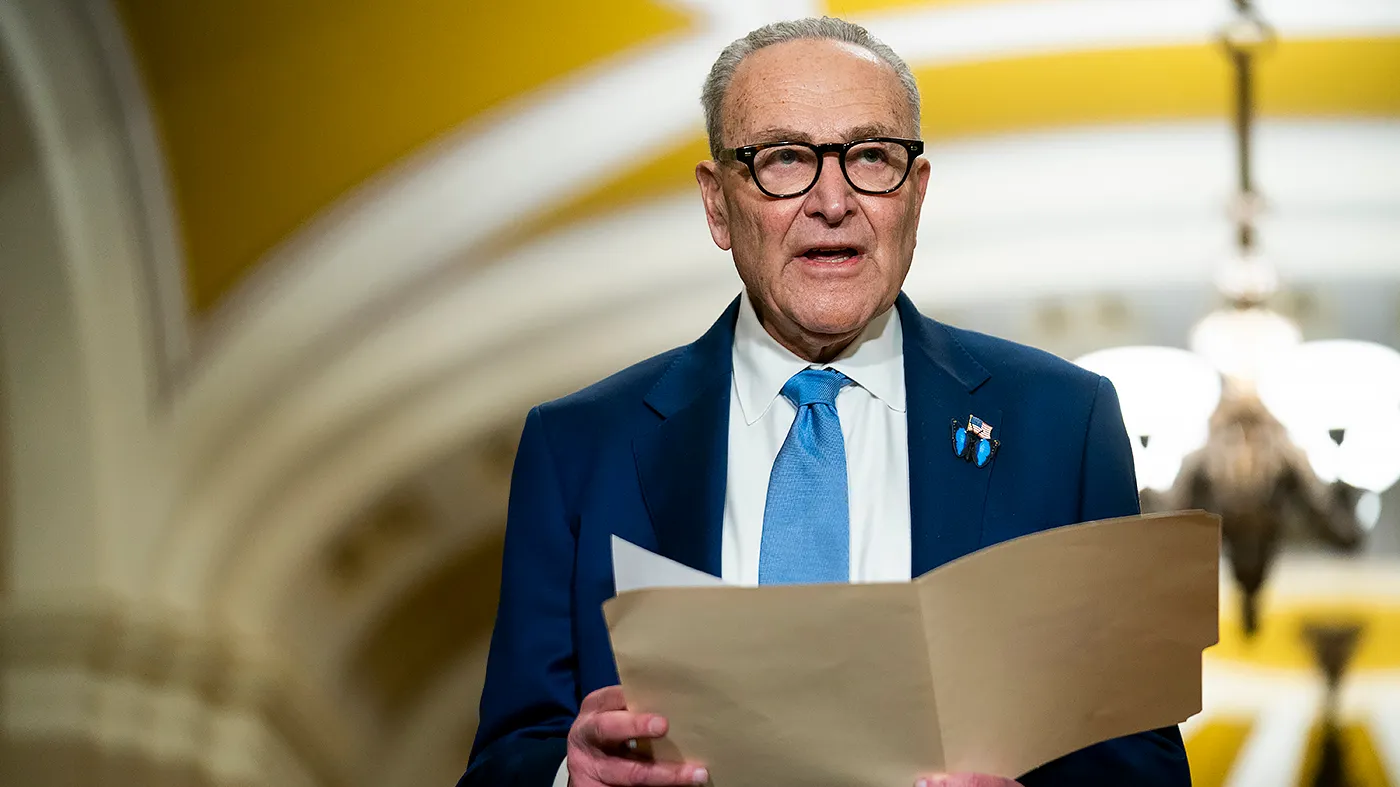
“Now the White House has formally notified Congress that hostilities have resumed, that American strikes are under way again and our forces remain positioned for more. Yet Republicans want the Senate to take up the NDAA, the defense bill, as though none of this is happening,” Senate Democratic Leader Chuck Schumer (N.Y.) declared on the Senate floor before the vote.
What the Bill Would Have Funded
The proposed legislation contained substantial funding allocations across multiple defense-related areas. The Department of Defense would have received $1.1 trillion, while the Department of Energy was slated to receive $41 billion for managing the nation’s nuclear arsenal. An additional $11 billion was earmarked for various other defense-related activities.
Beyond pure military spending, the bill included a 3.6 percent pay raise for active-duty troops. It also incorporated investments in education, housing, healthcare, and childcare programs designed to support military families.
Reactions and Criticism
The Democratic vote to block the defense bill drew sharp criticism from Republican leadership. Senate Armed Services Committee Chairman Roger Wicker (R-Miss.) characterized the move as “unprecedented” in Senate history.
“It’s unprecedented not to pass the motion to proceed on the NDAA and it reflects a decision and a mindset on the part of Sen. Schumer not to cooperate at all because so much of this has been done on a bipartisan basis,” Wicker stated. “It really is a new low.”
Senator Schumer had already signaled his position in a “Dear Colleague” letter sent on Monday, where he criticized Republican efforts to push “lopsided” legislation. He argued that these bills substantially increased defense spending while neglecting non-defense programs.
“There is nothing normal about putting forward a lopsided proposal that shuts down bipartisan input and jams through one-sided bills that shortchange families, prolong a war, and shield corruption,” Schumer wrote in his letter.
Senator Chris Murphy (D-Conn.) offered additional criticism on Tuesday, describing the defense authorization bill as essentially a war-funding measure for a conflict that most Americans oppose.
“It’s a war-funding authorization bill. This is an authorization for the Iran war, a war that nobody in this country wants,” Murphy said.
Not all Democrats were firmly opposed to moving forward. Senator Jack Reed (D-R.I.), the ranking member of the Armed Services Committee, was among those wavering on whether to vote to begin debate on the bill, suggesting that divisions within the Democratic caucus remained.
The deadlock over the NDAA has broader implications, as it has ensnared not only the defense authorization bill but also the regular appropriations process, creating uncertainty about how the government will fund its operations in the coming months.