Sparks fly in first Iowa governor’s debate: 5 takeaways

Table of Contents
Iowa Governor Candidates Clash Over Residency, Wealth and Schools
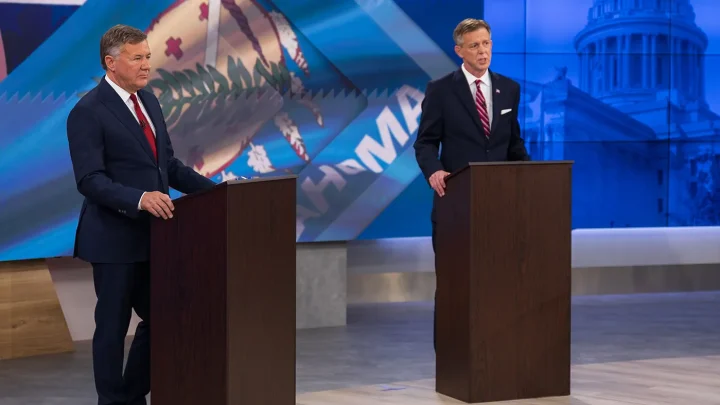
Provpnadvice.com – The first televised meeting between Republican Zach Lahn and Democrat Rob Sand quickly moved beyond campaign promises, becoming a sharp exchange over personal ties, family circumstances and the direction of Iowa’s public policy. With Gov. Kim Reynolds retiring, the two candidates are competing for an open governor’s office in a race Democrats view as a rare statewide opportunity.
The hourlong event took place Tuesday at St. Ambrose University in Davenport and was hosted by KWQC. Lahn and Sand are scheduled to meet three more times before Election Day, giving voters additional chances to compare their plans and their competing accounts of who is best positioned to lead the state.
Cook Political Report has rated the race for Reynolds’s seat as leaning Democratic. Iowa has not elected a Democratic governor in two decades, making Sand’s campaign an unusually consequential test for both parties.
Residency Becomes an Early Flashpoint
Sand pressed Lahn over his history of voting and residing in Kansas, arguing that the Republican has not shown a sufficiently deep or consistent connection to Iowa. The criticism centered on Lahn’s voter record and on questions about whether he could serve as a full-time governor while maintaining family ties across state lines.
“You literally voted in Kansas in 2018 and in ‘20 and in ‘22. You registered to vote in Iowa less than two years ago,” Sand said.
“This is not about why you’re in Kansas. This is about the fact that you’re not in Iowa,” he added.
Lahn has explained that he travels between Iowa and Kansas because his blended family includes children in both states. He co-founded a private school in Wichita and had voted in Kansas as recently as 2022. His campaign position has been that he spends most of his time in Iowa while remaining present for his children.
During the debate, Lahn rejected the suggestion that his family arrangement should undermine his candidacy. He said an election victory would require a changed arrangement and previously said his family would be in Iowa as much as possible.
“This issue is about one thing — it’s about my children. That’s it,” Lahn said. “I have a blended family, and they split time. And I’m going to tell you right now: I am not going to be intimidated on this.”
The dispute illustrates a central question likely to follow Lahn through the campaign: whether voters see his cross-state family situation as a personal responsibility or as a concern about his availability to govern from Iowa.
Lahn Targets Sand’s Family Connections
Lahn answered the residency attacks by focusing attention on Sand’s family wealth. Sand is married to Christine Lauridsen Sand, chief executive of Lauridsen Group, a collection of six companies involved in health and nutrition. Her parents, Nixon and Nancy Lauridsen, have contributed millions of dollars to Sand, while his wife and other relatives have also supported his run for governor.
Lahn has lent money to his own campaign, although his self-financing has been substantially smaller. His line of attack sought to frame Sand as a candidate insulated by major family resources.
“Rob, you’re now encountering somebody who’s not going to be intimidated by how much money your family has — it just won’t happen,” Lahn said.
For voters, the exchange offered two different arguments about independence. Sand’s opponents may question the role of family money in the campaign, while Sand can point to his own statewide experience and argue that fundraising support does not determine his public priorities.
Culture-War Issues Take Center Stage
The candidates also diverged over gender identity, transgender rights and school policy. Lahn accused Sand of supporting the promotion of gender ideology and transgender-related material in classrooms, citing Sand’s response to a July question about whether books addressing transgenderism should be prohibited in elementary schools.
“You just in July were sitting with somebody who’s asking you if you’d be banning books on transgenderism in elementary school classrooms, and you said ‘no,’” Lahn said. “You said you’re not going to take on the culture war bills, which just means that you would allow a book on transgenderism to be put in an elementary school.”
Sand’s public position has not fit neatly into either party’s broadest rhetoric on the issue. He has said transgender girls and women should not compete in women’s sports leagues. At the same time, he objected to Iowa’s 2025 law removing gender identity from the Iowa Civil Rights Code.
“You should not be fired from your job in the state of Iowa for being different. You should not be evicted from your apartment,” Sand said at a town hall last year.
That contrast is likely to remain important as each candidate tries to appeal to voters concerned about schools, civil-rights protections and the role of state government in cultural disputes.
Education Offers a Policy Divide
Education emerged as another major subject, with Sand using Nebraska’s recent public-school investment as an example of the kind of priority he believes Iowa should consider. He praised Republican Nebraska Gov. Jim Pillen while discussing Iowa’s lower-ranked school system, emphasizing that school funding is not inherently a partisan issue.
“Let me praise a Republican: The Nebraska Governor, Jim Pillen, actually put the biggest single investment in Nebraska history into Nebraska public schools. That’s part of the reason that they’re beating us now,” Sand said.
Nebraska established its Education Future Fund in 2023. Sand’s reference to the program allowed him to make a broader argument: that Iowa’s next governor should concentrate on strengthening public education and competitiveness rather than treating every policy debate as a partisan fight.
The opening debate did not settle the campaign’s biggest questions. Instead, it set the tone for a contest in which biography, money, education and social policy may matter as much as the candidates’ governing agendas. With three more debates remaining, Lahn and Sand will have repeated opportunities to clarify their plans—and to test whether voters are persuaded by their attacks on one another.
Related Reading
Frequently Asked Questions
What is Sparks fly in first Iowa governor?
Sparks fly in first Iowa governor is the main topic of this guide. The article explains the context, practical details, and next steps readers should understand.
Why does Sparks fly in first Iowa governor matter?
Sparks fly in first Iowa governor matters because readers are looking for a useful answer, not just a short summary. Good content should match search intent and help them decide what to do next.