
Why we should care about what’s happening with Donald and Natalie

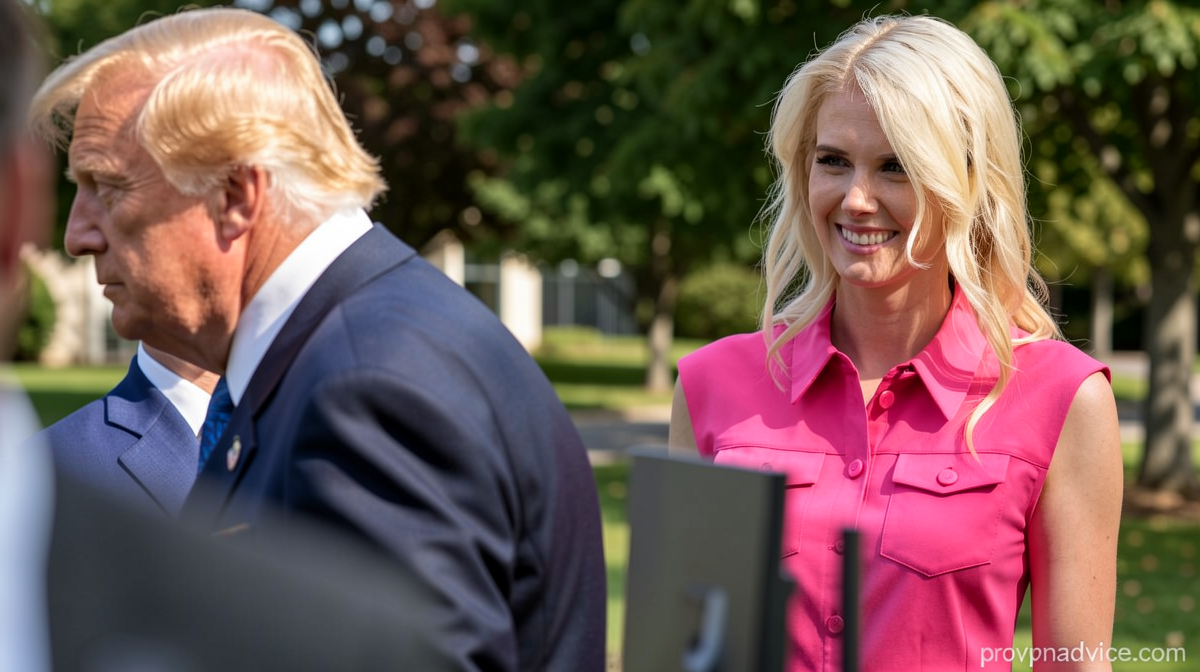
Table of Contents
The Spectacle of Flattery and the Silence on Suffering
Provpnadvice.com – Washington’s attention span has once again narrowed to a single corridor: the one connecting the Oval Office to the desk of Natalie Harp, President Donald Trump’s special assistant. For weeks, commentators have dissected every interaction between the two, parsing tone, proximity, and phrasing as though the fate of the republic hinges on whether a subordinate offers a compliment at the right hour. The spectacle is, of course, entirely predictable. What is less predictable is what the spectacle obscures.
While cable panels debate whether Harp’s devotion constitutes professional conduct or something stranger, the material conditions of American workers have deteriorated in ways that receive far less airtime. The disconnect is not accidental. It is structural — a pattern in which Republican leaders perform outrage over perceived slights against their own while remaining silent, or worse, gleeful, about the consequences of their own policies on the people they claim to represent.
A Convenient Feminism
The defense of Harp has come, predictably, from figures who have spent decades opposing the very protections that working women depend on. Newt Gingrich, of all voices, has positioned himself as guardian of “working professional women” against those who deploy “misogynistic language” to belittle women “simply doing their job.” The irony is not lost on anyone who watched the same cohort cheer as Project 2025’s blueprint for mass federal workforce reductions was executed by Elon Musk and Russell Vought. Hundreds of thousands of federal employees — a majority of them women, many of them women of color — lost their positions in that purge. No one from the Gingrich wing of the party rallied to their defense. The prevailing mood was not concern. It was satisfaction.
Trump himself has shown no shortage of appetite for what he considers appropriate language aimed at journalists, members of Congress, and Supreme Court justices. The standard applied to Harp is, to put it mildly, selective.
The Economic Ledger
The numbers tell a story that no amount of media theater can soften. In his first year back in office — before the decision to launch military action against Iran sent fuel prices and economic anxiety spiraling upward — the administration had, in the words of the Economic Policy Institute, “actively made life less affordable for working people.” The institute identified the central mechanism: a systematic erosion of workers’ bargaining power.
“His policies have systematically stripped workers of leverage in the labor market, driving down pay and making it harder for working families to afford the basics.”
The characterization is not hyperbole. The administration has pursued what can only be described as the most aggressive anti-union agenda in American history, dismantling protections that had accumulated over decades. Simultaneously, a sweeping deregulation campaign has removed “dozens upon dozens of rules” that shielded workers from occupational illness, injury, and uncompensated labor. The result is a workforce that is less safe, less compensated, and less able to organize.
In June, Senator Elizabeth Warren (D-Massachusetts) published a report cataloguing what she called “10 Ways President Trump Has Hurt American Workers.” Her summary was blunt:
“Donald Trump promised American workers he’d have their backs, then turned on them once he took office. He’s made it harder for workers to get a job and join a union, and easier for giant corporations to deny benefits and endanger workers.”
Beyond labor and safety rollbacks, the report pointed to the undermining of the National Labor Relations Board and to a trade policy that has generated uncertainty through erratic tariff actions and confrontations with close allies. Industries ranging from bourbon distilling to automobile manufacturing have felt the tremor. Small businesses dependent on cross-border commerce and tourism have been caught in the crossfire.
Enrichment and the Rigged Game
While workers absorb these costs, the Trump family has collected billions of dollars in revenue streams that would have been unthinkable a decade ago. The latest scheme involves monetizing the president’s social media posts — selling early access to Wall Street insiders who will trade on information designed to move markets. Each new arrangement tightens the grip of insider advantage over ordinary participants in the economy.
The indifference is not limited to economics. Soldiers and sailors are carrying the operational burden of a war launched without a coherent exit strategy. Families are contending with elevated gas prices that cascade into higher costs for groceries, commuting, and heating. Immigrant communities face the terror of mass deportation operations. Children and families are exposed to the consequences of an administration that has moved to weaken public-health infrastructure, including vaccination programs.
Why the Harp Story Captivates
Understanding the fixation on Harp requires recognizing what it substitutes for. When a president’s most visible act of personal loyalty is directed at a subordinate whose primary function is flattery and late-night amplification of his rhetoric, the spectacle becomes a proxy for every other question the public would rather not ask. Why does the person who stripped workers of leverage, started a war without a plan, and funneled billions into family enterprises receive such tender treatment from the media ecosystem that should be scrutinizing him? Why do cabinet members who degrade themselves to earn his approval find their professional futures secured by a single well-timed compliment?
The answer, ultimately, is that the spectacle is cheaper than the substance. It is easier to debate whether a woman’s devotion to her boss constitutes a scandal than to confront the fact that the boss has made life materially worse for tens of millions of Americans while enriching himself and his circle. The melodrama around Harp is not the story. It is the curtain. And behind it, the workers, the veterans, the immigrants, and the small-business owners are still waiting for someone in power to treat their suffering as newsworthy.
Related Reading
Frequently Asked Questions
What is Why we should care about what?
Why we should care about what is the main topic of this guide. The article explains the context, practical details, and next steps readers should understand.
Why does Why we should care about what matter?
Why we should care about what matters because readers are looking for a useful answer, not just a short summary. Good content should match search intent and help them decide what to do next.
