Early government projection showed thousands of Americans at risk of harmful exposure after East Palestine train derailment

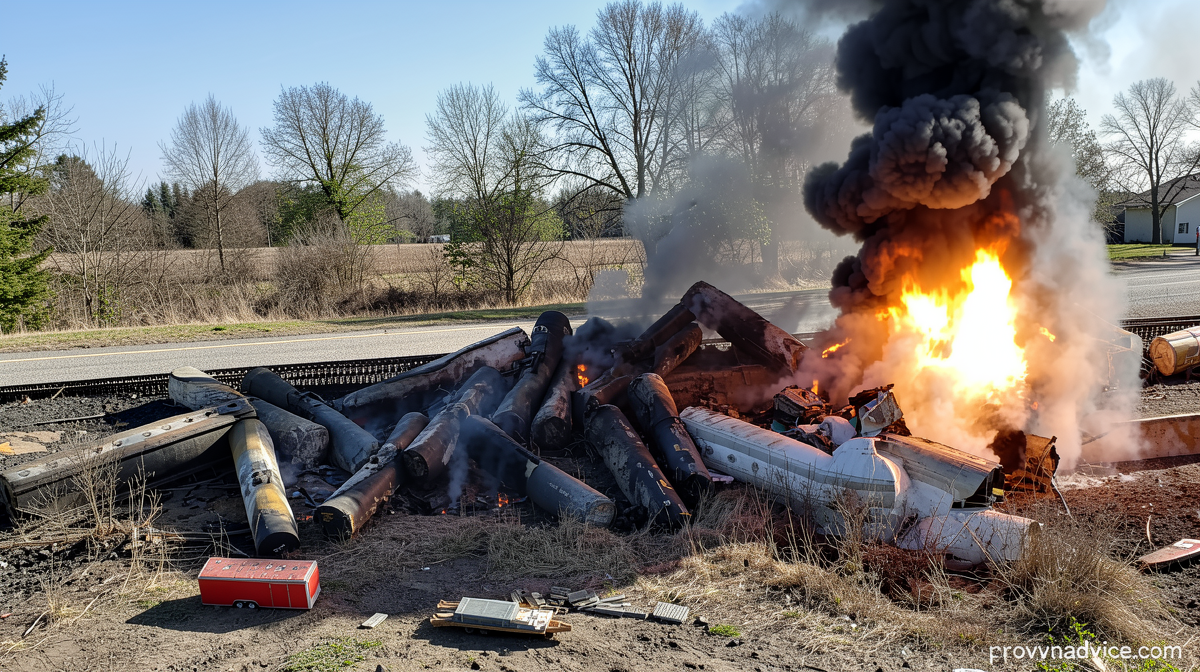
Table of Contents
Hidden Projections: What Federal Models Showed About Chemical Exposure After the East Palestine Derailment
Provpnadvice.com – In the chaotic aftermath of a freight train derailment that tore through a small Ohio town in early 2023, federal scientists ran atmospheric dispersion models that painted a far more alarming picture of chemical exposure than residents were ever told. Internal projections, now surfaced through a series of freedom-of-information requests, indicated that nearly eighteen thousand people in the immediate vicinity could have inhaled phosgene at concentrations capable of causing severe injury, while a smaller but still substantial number faced hydrogen chloride levels that could prove fatal. Those numbers were never communicated to the public.
The derailment occurred near East Palestine, a community of roughly 4,000 residents tucked along the Ohio-Pennsylvania border. Among the chemicals released from ruptured tank cars was vinyl chloride, a volatile compound widely employed as a feedstock in the manufacture of polyvinyl chloride (PVC) piping and other plastics. Once dispersed into air, vinyl chloride can undergo chemical breakdown, yielding two byproducts of particular concern: phosgene, a pulmonary irritant notorious for causing delayed lung damage, and hydrogen chloride, which forms a corrosive acid mist on contact with moisture. Both substances are well documented in industrial toxicology as agents capable of producing acute respiratory injury at relatively low concentrations.
The Numbers Behind the Smoke
Documents obtained by the Government Accountability Project, a nonprofit watchdog organization, show that the federal Interagency Modeling and Atmospheric Assessment Center produced its first exposure estimates within twenty-four hours of the derailment. That initial run projected that 17,972 individuals could encounter phosgene and 312 could encounter hydrogen chloride at levels described in the modeling output as capable of producing “at least severe injury.” A separate, more severe tier of the same model placed 1,901 people within a phosgene exposure zone and 185 within a hydrogen chloride zone characterized as “hazard levels that could possibly result in death.”
In the hours and days that followed, subsequent model iterations yielded dramatically lower exposure counts as more precise data on wind direction, release rates, and terrain became available. Residents who had been ordered to evacuate were eventually permitted to return. Yet the question that has since drawn scrutiny is whether the initial, worst-case figures should have been shared with the public while evacuation was still in effect.
Transparency Under Question
Lesley Pacey, senior environmental officer at the Government Accountability Project, framed the issue bluntly in a written statement:
“The government modeled thousands of casualties, then buried the maps and let residents walk back into the plume.”
Pacey further noted the procedural hurdles required to obtain the records:
“It took a whistleblower declaration and six federal agency FOIA requests before DOD [Department of Defense] produced what the public should have been told from the beginning.”
The implication is significant. In chemical-spill response, the window between initial release and public notification determines whether communities can take protective actions—sealing windows, relocating to upwind shelters, or simply remaining outside. If the most conservative model suggested thousands at risk of severe injury or death, the argument goes, that information belonged in the public domain before evacuation orders were lifted.
Agency Responses
An Environmental Protection Agency spokesperson, speaking without attribution, stated that EPA personnel arrived on-site “within hours of the derailment” and maintained ongoing communication through a website, a welcome center, community meetings, and a newsletter. The spokesperson characterized the initial model as one that “assessed an absolute worst-case scenario” and explained that updated projections were generated as field data accumulated. Those revised models, the spokesperson added, were shared with state and local officials.
A Federal Emergency Management Agency spokesperson offered a more pointed response, describing the episode as “yet another Biden cover up at the expense of the American people” and asserting that “these documents raise serious questions about what the Biden Administration knew, when it knew it, and why the public was not given the full picture.” The same spokesperson added that FEMA “cannot speculate on prior officials’ motives, but communities facing hazardous materials incidents deserve timely, accurate, and transparent information.”
State-Level Reactions
Dan Tierney, spokesperson for Ohio Governor Mike DeWine (R), confirmed in an email that the initial projections were generated before the evacuation order was issued and that removing residents from the area “would have dramatically reduced any potential impact.” Tierney noted that later modeling “did not show widespread areas affected at a level that would suggest serious health consequences.”
The office of Pennsylvania Governor Josh Shapiro (D) pointed out that because the derailment occurred on Ohio soil, the Commonwealth lacked direct jurisdiction over the site. The Shapiro administration acknowledged that the modeling represented an initial worst-case scenario and that subsequent runs indicated more limited geographic impact.
A Politicized Aftermath
The derailment quickly became a partisan flashpoint. President Donald Trump repeatedly criticized the Biden administration’s handling of the event and singled out then-President Biden for not visiting East Palestine until roughly a year after the accident. The Biden administration, in turn, defended its response and directed blame toward Republican-era regulatory frameworks that it characterized as permitting laxer oversight of rail transport of hazardous materials.
For residents of East Palestine and neighboring communities, the political contest has overshadowed a more fundamental question: whether the information architecture of federal chemical-spill response adequately protects the right of ordinary citizens to know what models say about their own air, in real time, before they are told it is safe to go home.
Related Reading
Frequently Asked Questions
What is Early government projection showed thousands of Americans?
Early government projection showed thousands of Americans is the main topic of this guide. The article explains the context, practical details, and next steps readers should understand.
Why does Early government projection showed thousands of Americans matter?
Early government projection showed thousands of Americans matters because readers are looking for a useful answer, not just a short summary. Good content should match search intent and help them decide what to do next.