Jeffries responds to Kushner meeting backlash: ‘No one from the Trump Cartel is getting a pass’

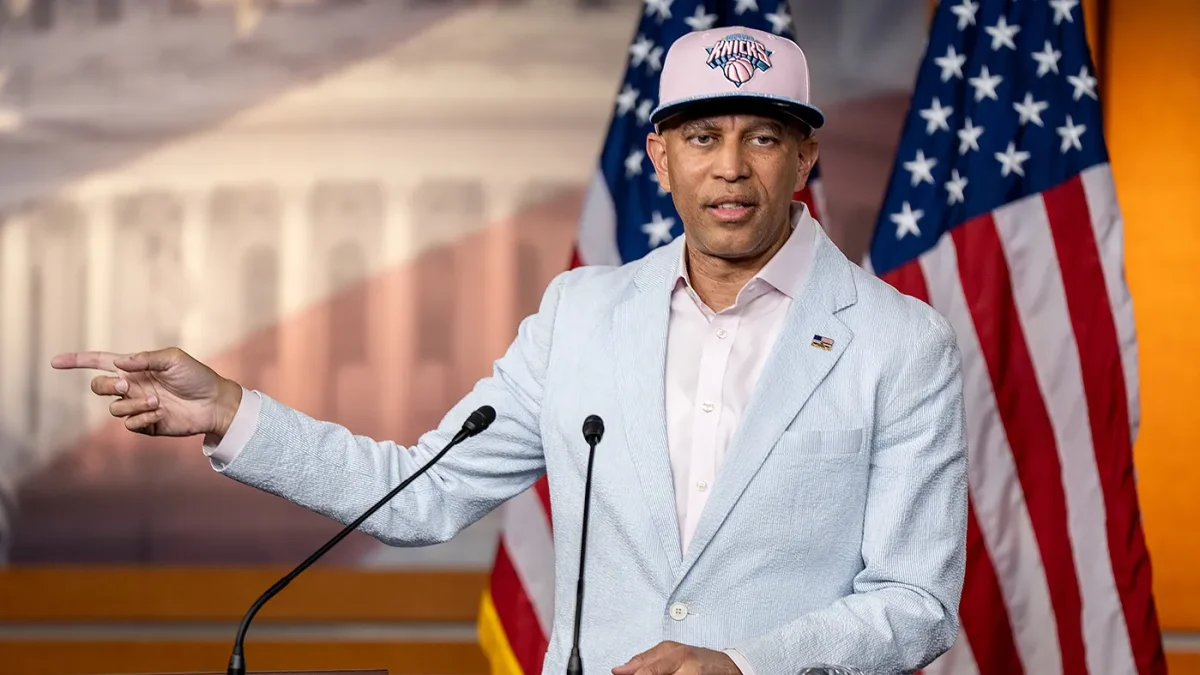
Table of Contents
House Minority Leader Faces Firestorm After Private Sit-Down With Jared Kushner
Provpnadvice.com – The political temperature in Washington spiked sharply this week after House Minority Leader Hakeem Jeffries (D-N.Y.) confirmed he had held a private meeting with Jared Kushner, the son-in-law of President Donald Trump, ahead of the November midterm elections. What was intended as a bipartisan conversation on shared policy priorities quickly became a flashpoint, drawing sharp criticism from across the political spectrum and forcing Jeffries to issue a pointed public defense of his decision.
On Monday, the New York Democrat took to the social media platform X to address the growing outcry. His message was blunt and unapologetic, drawing a line between productive dialogue and capitulation.
“I shouldn’t have to say it, but I am. No one is going to get a pass. We’re gonna follow the facts, apply the law, and be guided by the Constitution beginning on day one. And hold the crooks accountable.”
The phrase “Trump Cartel” — used in his post to describe the inner circle surrounding the president — landed with particular force in a political environment where many Democrats view the administration’s family-linked business dealings as a structural conflict of interest. Jeffries’ language signaled that he would not allow the optics of the meeting to soften his party’s oversight posture.
What Was Discussed, and Why It Mattered
The New York Times broke the story on Sunday, revealing that the two men had met privately to explore common ground on a handful of pressing domestic issues: housing affordability, immigration policy, and the broader cost-of-living squeeze facing American households. Jeffries stated that Kushner initiated the contact and that he agreed to the conversation specifically to advance the affordability agenda.
The timing made the meeting politically sensitive. With midterm elections weeks away, any appearance of Democratic leaders engaging in back-channel diplomacy with Trump family members risks being framed by opponents as evidence of weakness or collusion. Housing and cost-of-living pressures, however, remain among the top concerns of voters in both parties, which gives the subject matter a degree of legitimacy even when the participants are political adversaries.
Jeffries stressed that the meeting did not represent a retreat from his party’s legislative agenda. House Democrats, he noted, have pressed the administration on tariffs, protections under the Affordable Care Act, and nutritional assistance programs. The Kushner conversation, in his framing, was additive rather than substitutive — a separate track running alongside formal oversight.
Criticism From the Right and the Independent Left
Reactions were not confined to one side of the aisle. Tommy Vietor, co-host of the podcast “Pod Save America” and a former aide in the Obama White House, used X on Sunday to take aim at Kushner’s role in the administration.
“Jared Kushner has no actual government job he just uses his family connections to get money from gulf autocrats and fund corrupt deals.”
Vietor’s comment tapped into a recurring criticism among progressive commentators: that Kushner’s influence in the Trump administration operates through informal channels and personal relationships rather than through a formal cabinet or agency position. That perception made the private meeting with a House leader look, to some observers, less like diplomacy and more like a backroom arrangement.
On the Republican side, Speaker Mike Johnson (R-La.) sought to minimize the episode during an interview with Fox News’s Peter Doocy on “The Sunday Briefing.” Johnson suggested the meeting was inconsequential and that Kushner does not play a central role in daily White House operations.
“I don’t know what that’s about. I know Jared has interest in lots of other things going on. He’s not really directly involved in the admin, at least in the day-to-day in the White House.”
Johnson’s dismissal, however, sat uneasily alongside the fact that Kushner has been deployed by Trump as a foreign envoy working on conflict mediation in Ukraine, Gaza, and Iran — roles that carry substantial diplomatic weight even if they fall outside the traditional State Department structure.
Democratic Solidarity and the Road to November
Within the Democratic caucus, the meeting drew support rather than division. New York City Mayor Zohran Mamdani (D) used a Monday press conference to reaffirm his backing of Jeffries, specifically endorsing the representative’s bid to become House Majority Leader should Democrats reclaim the chamber in November.
“I continue to support Congressman Jeffries and his bid to become the leader,” Mamdani said.
Jeffries, for his part, framed the episode as further evidence that his party’s oversight work is producing tangible results. He pointed to the departures of former Attorney General Pam Bondi and former Secretary of Homeland Security Kristi Noem as proof that sustained pressure yields accountability.
“[Former Attorney General] Pam Bondi is gone. [Former Secretary of Homeland Security] Kristi Noem is gone, and we’re just getting started.”
He closed his remarks by returning to the economic anxieties that motivated the Kushner conversation in the first place.
“People are drowning in this failed economy and are demanding action. We have a responsibility to deal with the fact that life is too expensive. And that’s what we intend to do.”
Broader Implications
The episode underscores a recurring tension in American politics: the gap between the need for bipartisan problem-solving on issues like housing and immigration, and the electoral incentive to signal zero concessions to the opposing party. Jeffries’ decision to meet Kushner — and then to publicly insist that the meeting carried no implicit pardon — represents an attempt to thread that needle. Whether voters in swing districts will reward the pragmatism or punish the optics remains the central question heading into November.
For the administration, the episode also highlights the reputational cost of informal family-linked diplomacy. Kushner’s foreign-policy assignments in Ukraine and Gaza have already drawn scrutiny; a private policy conversation with the House minority leader adds another data point to critics’ argument that the boundary between statecraft and family business remains porous. As the midterm calendar tightens, both parties will be watching to see whether this meeting was a one-off overture or the opening move in a longer negotiation.
Related Reading
Frequently Asked Questions
What is Jeffries responds to Kushner meeting backlash?
Jeffries responds to Kushner meeting backlash is the main topic of this guide. The article explains the context, practical details, and next steps readers should understand.
Why does Jeffries responds to Kushner meeting backlash matter?
Jeffries responds to Kushner meeting backlash matters because readers are looking for a useful answer, not just a short summary. Good content should match search intent and help them decide what to do next.