
Australia and EU strike free trade deal
Australia and EU strike free trade deal
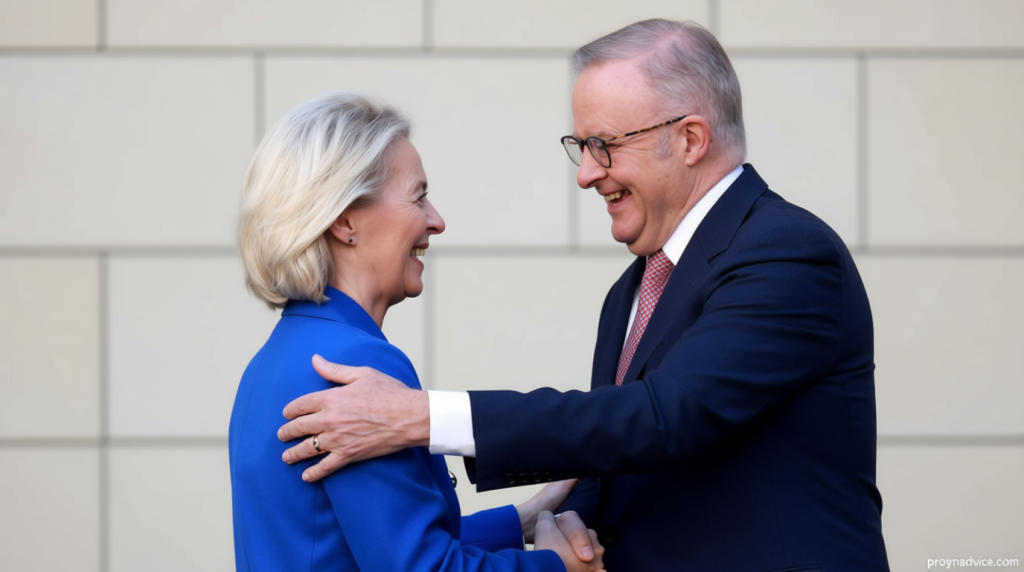
The European Union and Australia have finalized a groundbreaking trade agreement aimed at enhancing economic ties amid shifting global trade dynamics. This pact, which followed years of discussion, represents a major step for both nations to strengthen their commercial relationships. The deal was announced in Canberra, where EU President Ursula von der Leyen and Australian Prime Minister Anthony Albanese highlighted the partnership’s importance.
As part of the agreement, the EU and Australia will eliminate over 99% of tariffs on goods traded between them. This will save companies an estimated €1 billion annually in import duties, according to AFP. The terms include immediate tariff cuts for wine, sparkling wine, fruit, vegetables, and chocolates, while cheese reductions will take effect gradually over three years. Additionally, Australia will lower tariffs on critical minerals, benefiting industries reliant on raw materials.
“The EU and Australia may be geographically far apart but we couldn’t be closer in terms of how we see the world,” von der Leyen remarked during her meeting with Albanese. “With these dynamic new partnerships on security and defense, as well as trade, we are moving even closer together.”
Albanese described the deal as a “significant moment” for Australia, emphasizing its potential to boost trade volumes. The European Union is currently Australia’s third-largest trading partner and second-largest source of foreign investment. The agreement also includes a security and defense collaboration, signaling deeper strategic alignment between the two regions.
Key challenges during negotiations centered on market access for Australian beef and the use of geographical product names. The EU has agreed to grant a total of 30,600 tons of beef tariff rate quotas, with 55% of grass-fed beef entering duty-free and the remaining 45% subject to a reduced 7.5% duty, phased in over five years to support EU farmers. For sheep and goat meat, Australia will secure a 25,000-ton quota over seven years. Earlier disputes involved the right of Australian producers to label wines and cheeses with names like prosecco and feta, which are protected under EU designations. The compromise allows Australia to retain these labels for existing producers but restricts their use for new products after a 10-year transition.
Australian Trade Minister Don Farrell previously stated that the deal would generate around 10 billion Australian dollars in additional trade within its first year. The finalization of the agreement depends on approval from the European Council and Australia’s parliament, after which it will be formally signed. The pact is expected to increase EU exports to Australia by 33% over the next decade, with motor vehicles, chemicals, and daily necessities projected to see the most substantial growth.
