Tiffany, Crowley tangle in only Wisconsin governor’s debate: 3 takeaways

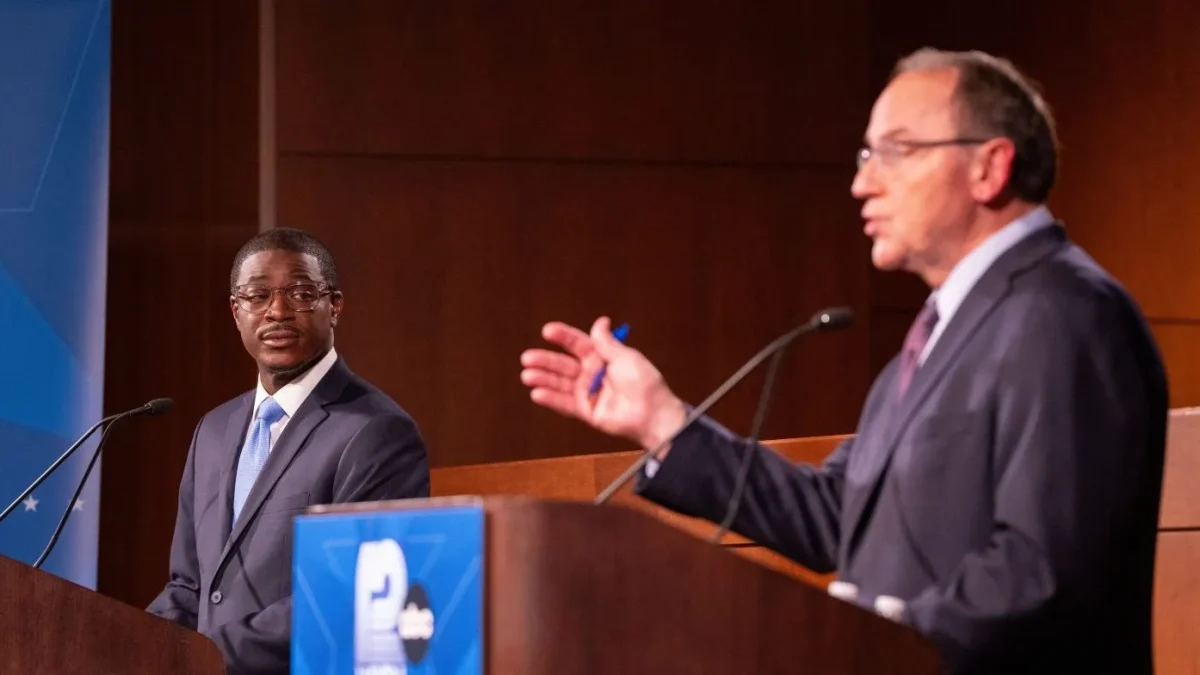
Table of Contents
Wisconsin Governor’s Race Highlights Election Claims, Abortion and Party Divides
Provpnadvice.com – Democrat David Crowley and Republican Tom Tiffany used their only scheduled debate in Wisconsin’s race for governor to draw sharp contrasts on election administration, abortion policy and ideological divisions within their parties. The candidates are competing to replace retiring Democratic Gov. Tony Evers, with early voting beginning Tuesday.
Crowley, Milwaukee County’s executive, and Tiffany, a Republican member of Congress, appeared in the debate hosted by WISN 12. The contest remains closely watched: earlier polling gave Crowley a small advantage, while nonpartisan election forecasters Cook Political Report and Inside Election classify the race as a toss-up. Decision Desk HQ lists Wisconsin as leaning Democratic.
Tiffany Defends 2020 Certification Vote
One of the evening’s most pointed exchanges centered on Tiffany’s vote against certifying electoral results from Pennsylvania and Arizona following the 2020 presidential election. When first questioned about the decision, Tiffany attempted to redirect the discussion toward Crowley before returning to explain his position.
Tiffany cited concerns over private funding used to assist election offices during the pandemic, often described by conservative critics as “Zuckerbucks.” The phrase refers to grants distributed by the Center for Tech and Civic Life to local governments administering the 2020 election. Much of the organization’s funding came from Meta CEO Mark Zuckerberg.
“We should not allow private money to go into what is a public process, our elections,” Tiffany said. “That’s why I objected because the people of the state of Wisconsin — they did not want that, and by the way, the people of the state of Wisconsin have voted to enshrine photo ID into our constitution.”
Critics of the grants have argued that the money was improperly used and aided Democrats. Election officials and audits, however, found no evidence of broad fraud in the 2020 election. Former President Joe Biden won that presidential contest, despite repeated claims by former President Donald Trump that it had been stolen or rigged.
Trump, who backs Tiffany in the governor’s campaign, has continued to challenge the legitimacy of the 2020 result. Tiffany was among nearly 150 Republican lawmakers who opposed certification of results in Pennsylvania and Arizona.
Crowley framed his response as a defense of confidence in election systems and a willingness to accept an unfavorable result.
“We’ve always had free and fair elections. I believe in the integrity — that’s how I know that Donald Trump lost the race in 2020, and I can admit that while being on TV,” Crowley said.
The exchange underscored how debates over the 2020 election continue to shape statewide campaigns. For Wisconsin voters, the issue also carries particular weight because the state has repeatedly been a closely contested presidential battleground.
Crowley Creates Distance From Democratic Socialists
Crowley also faced questions about the Democratic Socialists of America and his relationship to policy ideas associated with the organization. The topic has become a recurring Republican line of attack as candidates seek to define Democrats in ideological terms.
The Democratic nominee’s position appeared more guarded than remarks he made during the primary campaign. During the summer, when Democratic primary opponent Francesca Hong was gaining traction in polls, Crowley said he and Hong did not differ on many policies. Hong is a member of the Democratic Socialists of America.
On the debate stage, Crowley declined to embrace the group’s agenda, saying he did not know its platform well enough to address individual priorities.
“I’m not familiar with the DSA platform to be answering that question,” Crowley replied.
Republicans have frequently invoked the DSA while arguing that Democratic candidates hold communist or socialist views. In competitive states, Democratic candidates often seek to distinguish themselves from explicitly socialist contenders, especially where general-election voters may be less receptive to broader ideological labels.
The moment illustrated the balancing act facing Crowley: maintaining support from the Democratic coalition while presenting himself as a candidate focused on governing a politically divided state.
Abortion Positions Receive Close Scrutiny
Abortion was another central subject, reflecting its continued importance in Wisconsin politics after the state Supreme Court ruled last year that Wisconsin’s 1849 abortion restrictions were not in effect following the reversal of Roe v. Wade.
Tiffany was repeatedly asked whether he would approve legislation banning abortions after six weeks, measures commonly called fetal heartbeat laws. He said he would not sign such a ban if elected governor.
Instead, Tiffany pointed to the 20-week abortion law he supported while serving in the Wisconsin Legislature and said he would preserve that policy.
Tiffany said he would “uphold it” if elected.
Crowley, meanwhile, did not directly answer whether he would sign legislation allowing abortion without any gestational limit. He argued that such decisions should remain in the hands of patients and medical professionals, while also questioning whether such a bill would ever arrive for a governor’s signature.
“These are decisions that need to be made between the patient and a healthcare provider. I don’t believe a law like that would ever actually reach my desk,” Crowley said.
The candidates’ answers showed both attempting to define limits around their positions. Tiffany rejected a six-week restriction while backing a 20-week framework. Crowley emphasized patient-provider decision-making but avoided committing to legislation with no gestational threshold.
With no additional debate planned, the event offered Wisconsin voters a rare direct comparison before Election Day. The discussion made clear that the campaign will continue to turn on familiar state and national fault lines: trust in elections, the boundaries of abortion law and the political identity each candidate brings to the office.
Related Reading
Frequently Asked Questions
What is Tiffany Crowley tangle in only Wisconsin?
Tiffany Crowley tangle in only Wisconsin is the main topic of this guide. The article explains the context, practical details, and next steps readers should understand.
Why does Tiffany Crowley tangle in only Wisconsin matter?
Tiffany Crowley tangle in only Wisconsin matters because readers are looking for a useful answer, not just a short summary. Good content should match search intent and help them decide what to do next.