New York supermarkets sue over Mamdani’s municipal grocery stores

Table of Contents
NYC Grocery Owners Launch Dual Legal Challenge Against Mamdani’s City-Run Store Plan
Provpnadvice.com – Two lawsuits filed Monday in New York State courts mark the most direct legal confrontation yet between the city’s existing grocery sector and Mayor Zohran Mamdani’s push to establish municipal food retailing. The filings, brought by a coalition of predominantly immigrant- and minority-owned grocery shops, argue that the administration’s plan to open five city-operated stores next year would systematically undercut independent grocers and violate constitutional guarantees of equal protection.
The Two-Track Legal Strategy
The plaintiffs, organized under the banner of the Multicultural Business Coalition, split their challenge into two distinct suits. The first, filed in state court, contends that the proposed municipal grocery program — internally designated “NYC-GP” in the filings — would deny equal protection to small grocers who cannot match the subsidized pricing of city-backed competitors. The second suit takes aim at the administrative process, alleging that the Mamdani administration failed to conduct a meaningful impact analysis before advancing a program that would price staple foods well below prevailing market rates.
The first complaint lays out its constitutional theory in blunt terms:
“Plaintiffs have been denied equal protection where the Plaintiffs, predominately immigrant and minority owned grocery stores, are unable to offer similarly discounted products of the NYC-GP, and therefore, the former are being unduly denied the equal protection of the subsidized municipal grocery stores (i.e., NYC-GP), where the Defendants have failed to take corrective action, namely meaningfully study and analysis to avoid furthering historic discriminatory exclusion, and exclusion generally.”
Attorneys representing the coalition appended a shorter summation: “Therefore, the Plaintiffs are suffering undue harm.”
The Pricing Mechanism at Issue
Under the plan as outlined by Mamdani’s office, the city would own the real estate and absorb fixed overhead costs — rent, construction, and related capital expenditures — while a private operator, chosen through a competitive request-for-proposals process, would handle day-to-day retail operations under a municipal contract. Once each month, the stores would benchmark their shelf prices against surrounding retailers and set food costs at roughly 30 percent below the prevailing market rate.
Mark Jaffe, president of the Greater New York Chamber of Commerce, who is representing the grocer plaintiffs, characterized the discount in the second filing as a rate that “rivals or exceeds Walmart discounts.” That comparison is deliberate. For decades, New York’s independent grocery sector has lobbied to keep large national discount chains from establishing operations inside city limits, fearing that an influx of low-margin, high-volume retailing would erase what the lawsuit describes as “an untold amount of opportunity for minority businesses and small business at large.” The plaintiffs now argue that a city-subsidized competitor would produce the same chilling effect without requiring a single Walmart to set foot on Manhattan or Brooklyn.
Scale and Funding
The five stores slated to open next year would be backed by approximately $70 million in taxpayer appropriations. In a city of roughly 8.5 million residents that already hosts more than a thousand grocery outlets, the administration frames the investment as a modest intervention aimed at a specific problem: the roughly 30 percent surge in grocery prices that has accumulated over the past several years.
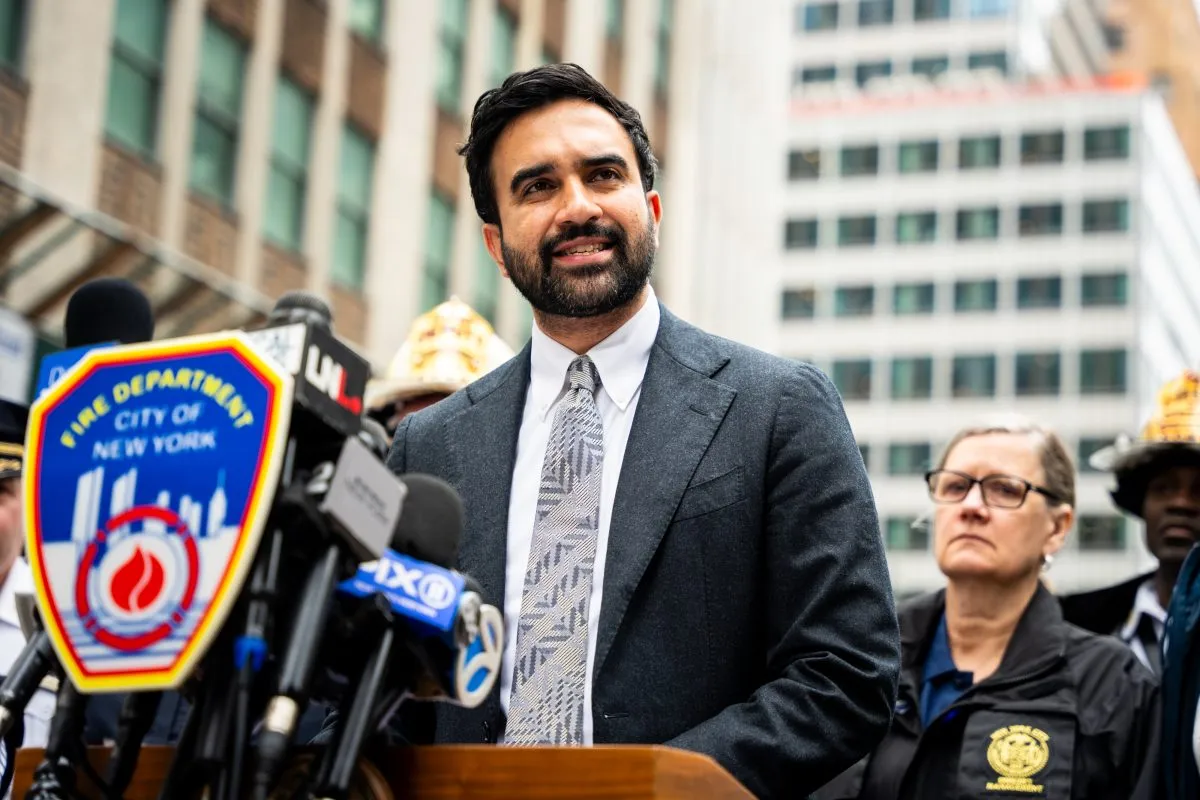
Mamdani addressed the plan at a Monday press conference, situating it within the broader cost-of-living crisis:
“We are talking about a reflection of a cost-of-living crisis that has seen grocery prices increase by about 30 percent over the last few years, and we’re also talking about delivering five city-run grocery stores in a city of 8.5 million people that has more than a thousand grocery stores.”
He pointed to two existing municipal markets as proof-of-concept:
“And we’ve seen, in fact, with Essex Street Market in Manhattan, as well as Moore Street Market in Brooklyn, a model where the city has subsidized groceries and it has not had a negative effect on bodegas around them or on grocery stores around them.”
What the Stores Would Actually Do
The operational model separates ownership from management. The city retains title to the land and buildings and shoulders the capital and fixed-cost burden. A private entity, vetted through a formal procurement process, would run inventory, staffing, and daily sales. The monthly price-reset mechanism is designed to keep the discount anchored to real market conditions rather than drifting over time. Mamdani has stated publicly that the program is intended to compress inflationary pressure on household food budgets, reduce overhead costs that small grocers cannot absorb, and stabilize shelf prices across all five boroughs while expanding affordable options for residents.
Why the Coalition Sees a Different Picture
For the plaintiffs, the distinction between a city-subsidized store and a private discount chain is largely academic. A grocer operating on thin margins in a neighborhood where a municipal competitor can legally price staples 30 percent lower faces a structural disadvantage that no amount of customer loyalty or community goodwill can offset. The coalition’s argument is that the administration’s failure to study this dynamic before committing $70 million constitutes both a procedural defect and a substantive civil-rights injury, particularly because the affected shops are disproportionately owned by immigrant and minority entrepreneurs.
The suits do not seek to block grocery retailing in New York; they seek to force the administration to demonstrate, before the first store opens, that the program will not function as a de facto exclusion mechanism against the very small businesses the city has historically pledged to protect. Whether a court will grant injunctive relief before next year’s planned openings remains to be seen, but the filings guarantee that the municipal grocery question will now be litigated in state courtrooms alongside the political debate in City Hall.
Neither Mamdani’s office nor Jaffe’s representatives responded promptly to requests for additional comment ahead of publication.
Related Reading
Frequently Asked Questions
What is New York supermarkets sue over Mamdani?
New York supermarkets sue over Mamdani is the main topic of this guide. The article explains the context, practical details, and next steps readers should understand.
Why does New York supermarkets sue over Mamdani matter?
New York supermarkets sue over Mamdani matters because readers are looking for a useful answer, not just a short summary. Good content should match search intent and help them decide what to do next.