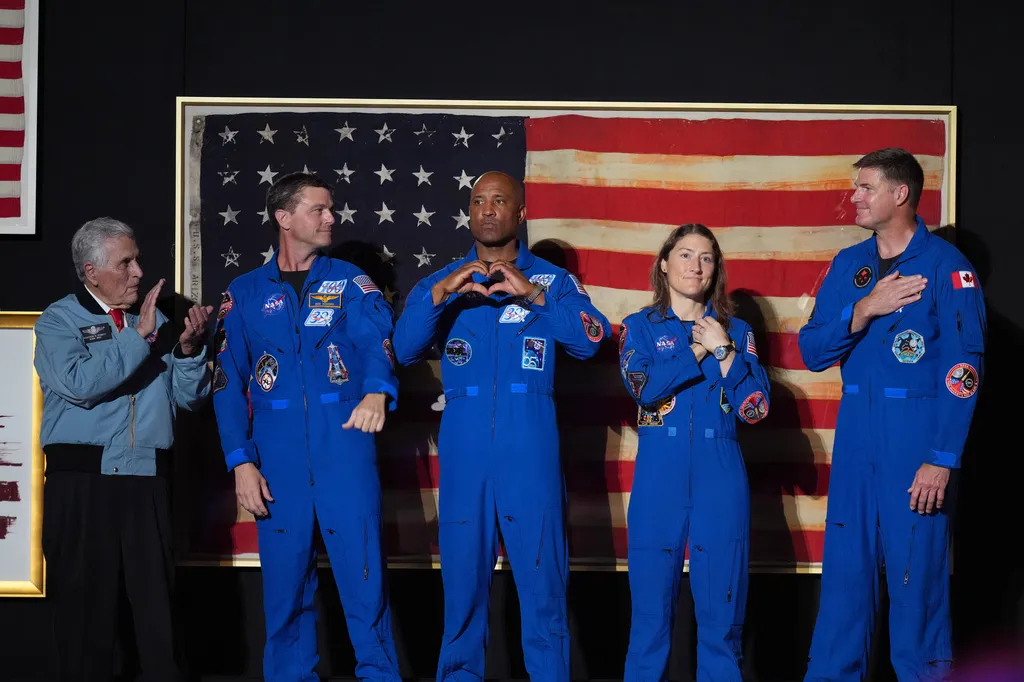
How should the moon and Mars be governed?

Table of Contents
Governance in the High Frontier: Who Sets the Rules for Lunar and Martian Settlement?
Provpnadvice.com – As NASA pushes the Artemis program toward a sustained human presence on the Moon and SpaceX’s Elon Musk continues to articulate a vision of a self-sustaining city on Mars, a question that once belonged purely to science fiction has become urgent policy terrain: who governs, and by what rules, once people actually live beyond Earth? The answer is not self-evident, and the debate has already produced sharply competing visions of how outer-space civilization should be organized.
A Proposed Council and Its Functions
Planetary scientist and self-described space ethics specialist Adriana C. Ocampo Uria has put forward a specific institutional answer. Writing in Space News, she advocates the creation of what she calls a “Planetary Stewardship Council” — a permanent body affiliated with the United Nations that would carry the ethical authority to define and enforce guardrails for space activity, adjudicate competing claims over resources, designate preservation zones around biologically sensitive sites, and mediate disputes over landing rights.
The architecture of the proposal is deliberately modeled on multilateral governance: a standing institution with binding ethical mandates, rather than ad hoc negotiations between individual missions. Ocampo frames it as a necessary corrective to what she sees as an unchecked competitive dynamic between the United States and China in space.
Criticism From Inside and Outside the Industry
The idea did not land well with NASA’s leadership. Administrator Jared Isaacman responded publicly on X, dismissing the notion as bureaucratic overreach:
“Bureaucracy has already throttled space exploration, and this article proposes creating a UN-affiliated ‘Planetary Stewardship Council?’ As a species, there are few things we actually agree upon here on Earth, so how could this possibly advance progress in space?”
Isaacman’s skepticism captures a broader unease within the space sector: the fear that a multilateral body, staffed by delegates from dozens of governments with divergent priorities, would slow or effectively halt the pace of exploration. Peter Hague, an astrophysicist, software engineer, and space-industry analyst, extends that concern, arguing that such a council would impose restrictions so severe that lunar and Martian colonization would be prohibited outright. In his view, the council’s personnel would gravitate toward treating outer space as a protected preserve for scientific study — essentially an Antarctica model transposed to the vacuum beyond low-Earth orbit.
An Existing Framework: The Artemis Accords
Yet a workable governance structure already exists, and it predates the council debate. The Artemis Accords, first articulated during the initial Trump administration, constitute a nonbinding multilateral agreement among nations that lays out operational rules for activity on celestial bodies including the Moon and Mars. Their scope is broad: data-sharing obligations, transparency requirements, and — critically — deconfliction protocols that define how separate actors avoid interfering with one another’s operations.
The deconfliction mechanism operates through designated safety zones surrounding lunar bases and future Mars settlements. Within those zones, other parties may not operate without explicit permission, thereby reducing the risk that one nation’s mission inadvertently disrupts another’s. The accords thus provide a practical, mission-level answer to the coordination problem that Ocampo’s council would address at a more abstract, institutional level.
Seventy nations have joined the Artemis Accords to date. The signatory list spans the full spectrum of space capability, from major powers such as the United States and India to smaller states including Rwanda and Singapore. Each signatory has committed to the provisions on equal terms, creating a shared normative baseline for lunar and Martian activity.
The Missing Signatories: Russia and China
The accords’ principal weakness is the absence of two major space powers. Russia has not signed, and China has not signed. Their non-participation means they feel no obligation to observe the accords’ deconfliction zones or transparency rules.
For Russia, the practical consequence may prove limited. President Vladimir Putin’s ongoing war in Ukraine has steadily eroded Moscow’s standing as a space power. Most recently, Ukrainian forces struck the rocket factory responsible for producing, among other hardware, the launch vehicle that carries cosmonauts to and from the International Space Station. A space program whose launch infrastructure is under active military attack faces existential constraints that no diplomatic objection can offset.
China’s refusal, by contrast, is a matter of deliberate policy. Beijing has declined to constrain its space ambitions within a cooperative framework. Rather than participating in shared governance of the Moon and Mars, it prefers a posture of unilateral dominance — a space-based empire pursued at the expense of other nations’ interests. A feel-good United Nations council, critics argue, would not correct this dynamic; it would merely furnish a diplomatic vehicle through which China could advance its imperial agenda under the veneer of multilateral legitimacy.
Sanctions, Succession, and a Possible Turning Point
For the present, the most realistic course available to the coalition of accords signatories is to use Earth-based economic instruments — trade measures, investment restrictions, targeted sanctions — to check Chinese expansion in space until Beijing recalibrates its posture. Fights over lunar regolith or Martian water ice, in other words, can be answered not by a new council chamber but by the levers of terrestrial economic statecraft.
The longer horizon is political succession. Xi Jinping will eventually go the way of Mao Zedong and be succeeded. If the next leader surveys the damage wrought by decades of confrontation and concludes that cooperation, not conflict, is the only viable path forward — a judgment Deng Xiaoping reached in China and Mikhail Gorbachev reached in Russia — then Beijing might finally accede to the Artemis Accords. Such a signature would mark the end of the current space race and the opening of a genuinely cooperative era.
Only under that condition, proponents of the accords argue, can humanity expand into the high frontier as a single species operating under shared rules, rather than as rival empires carving up celestial real estate.
Related Reading
Frequently Asked Questions
What is How should the moon and Mars?
How should the moon and Mars is the main topic of this guide. The article explains the context, practical details, and next steps readers should understand.
Why does How should the moon and Mars matter?
How should the moon and Mars matters because readers are looking for a useful answer, not just a short summary. Good content should match search intent and help them decide what to do next.