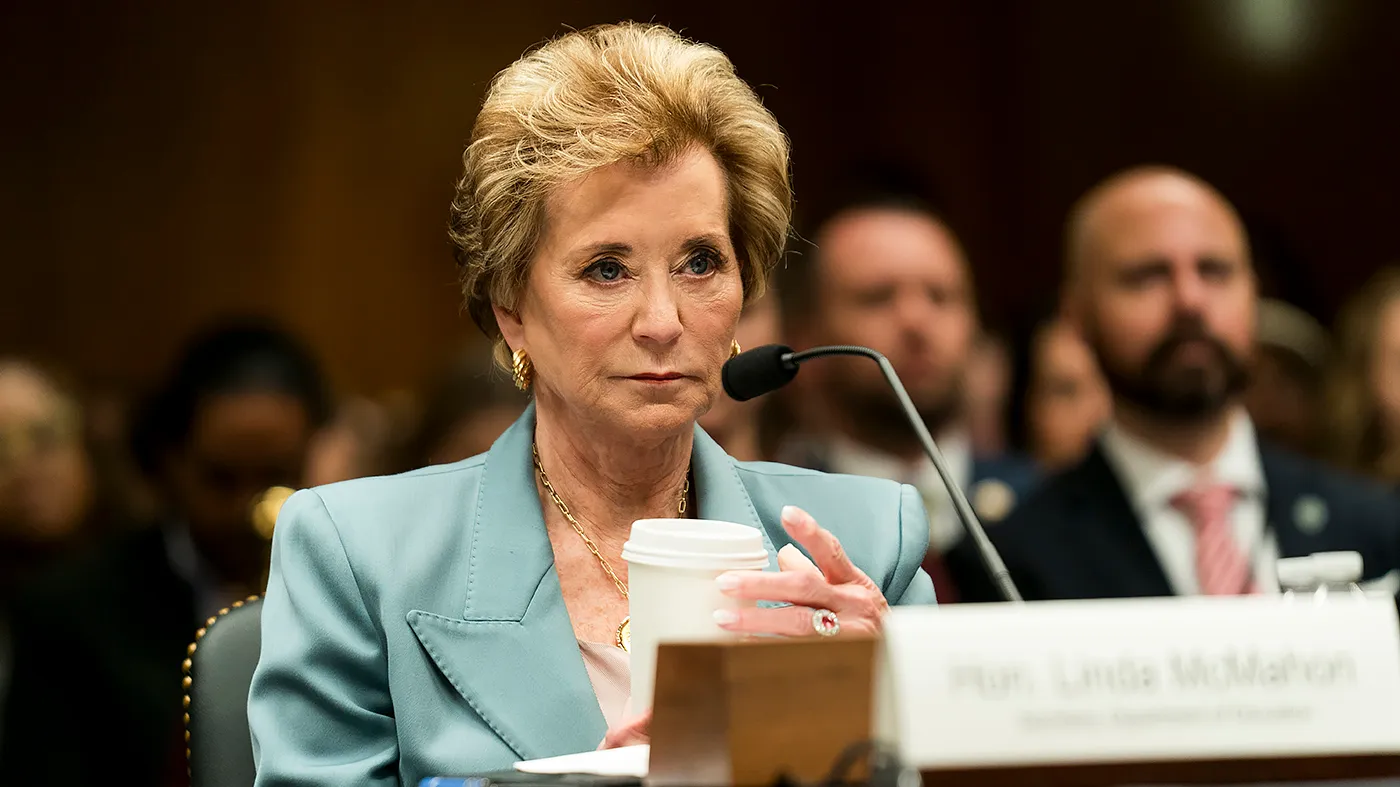
McMahon: AI can be a ‘great tool’ for students


Table of Contents
Federal Education Leader Calls for Cautious, Outcome-Driven AI Adoption in K-12 Classrooms
Provpnadvice.com – The question of how artificial intelligence should fit into American classrooms has moved from speculative debate to active policy territory. Education Secretary Linda McMahon addressed the issue directly on Sunday, telling viewers of CNN’s “State of the Union” that AI holds genuine promise for young learners — provided schools deploy it with clear purpose, active oversight, and measurable results. Her remarks landed amid a broader federal push to shape how districts integrate digital tools, signaling that Washington now views classroom technology not as a purely local matter but as a domain warranting national guidance.
Survey Data Shows Rapid Uptake Already Underway
McMahon’s comments arrive at a moment when AI use in schools has accelerated sharply. A survey conducted by the RAND Corporation found that last year, 54 percent of students and 53 percent of English, math, and science teachers reported using AI for schoolwork. Those figures represented jumps of more than 15 percentage points compared with surveys carried out over the preceding two years. The trajectory suggests that, whether or not policymakers have finished writing the rules, teachers and students are already experimenting with generative tools in homework, tutoring, and classroom activities.
That rapid adoption creates both opportunity and risk. On one hand, personalized learning paths powered by adaptive software can close gaps that a single teacher managing thirty students cannot address individually. On the other hand, unchecked deployment risks widening inequities, eroding foundational skills, or exposing minors to data-collection practices that have not been vetted for educational settings. McMahon’s public framing attempts to thread that needle: endorse the technology while insisting on guardrails.
A Visit to Alpha School Shapes the Secretary’s Assessment
McMahon grounded her remarks in a recent visit to the Alpha School in Austin, Texas, a private institution where students spend the “first couple of hours” of each day interacting with chatbot-based learning platforms. Teachers remain present throughout, watching screens and stepping in when a student’s trajectory drifts. Describing what she observed, McMahon told host Dana Bash:
“The beauty of that is that a student almost has a one-on-one tutor. So, the teacher can monitor to see if a child is a bit behind and repeat information for them. If a child is really excelling, then their programs get sped up a bit.”
She characterized the arrangement as “a great tool to have in this particular school,” emphasizing that the model works because human supervision sits atop the algorithmic layer rather than being displaced by it. The Alpha School example illustrates a hybrid approach: the machine handles repetition, pacing, and immediate feedback, while the educator handles judgment, emotional support, and curriculum alignment.
Department Guidance Demands Intentionality
Earlier in the same week, the Department of Education released guidance aimed at technology use in classrooms broadly, with explicit attention to artificial intelligence. Kirsten Baesler, assistant secretary overseeing the Office of Elementary and Secondary Education, penned a letter to K-12 school leaders urging institutions to become “increasingly intentional about the digital experiences” available to students. The letter frames the issue not as a binary choice between adopting or rejecting a tool, but as a question of fit: Does the technology serve a defined pedagogical purpose? Is it implemented under conditions that protect student welfare and learning integrity?
“The effectiveness of any educational technology depends on the quality of the tool, the purpose for which it is used, and the conditions in which it is implemented,” Baesler wrote. “Not only do we need to know if the tool works, but if it works; why does it work, for whom does it work, and under what conditions.”
The language echoes decades of educational-research methodology, which has long cautioned against evaluating interventions solely by average effect sizes. A tool that lifts outcomes for one demographic or grade band while leaving others stagnant — or worse, behind — fails the test even if its aggregate numbers look favorable. Baesler’s letter effectively asks districts to run that disaggregated analysis before scaling any AI deployment.
Outcomes as the Litmus Test
McMahon aligned herself with her assistant secretary’s framework, insisting that the ultimate arbiter of continued use must be student performance data. She posed the question plainly:
“Are we seeing better outcomes in schools? And if we’re not, then … they should be pulled out. But I have seen it work so well in the introductions that I’ve seen.”
She added that a gradual rollout, introduced “slowly in schools,” could make AI “a very effective tool used properly.” The phrasing underscores a phased-implementation philosophy: pilot, measure, adjust, and only then expand. It also implies that districts lacking robust assessment infrastructure may struggle to meet the outcome threshold the Secretary has set, potentially slowing adoption in under-resourced schools and deepening the digital divide the technology was meant to narrow.
Parental Opt-Out Preserved
One provision in McMahon’s remarks stands apart from the broader policy discussion: she affirmed that parents “have every right” to remove their children from AI-centered instruction if they are “not seeing” a positive outcome from the technology’s use. That statement, while brief, carries significant weight. It positions parental consent and ongoing consent as non-negotiable elements of any district’s AI plan, and it gives families a concrete lever — not merely a suggestion box — for contesting a particular implementation. In practice, districts will need to define what counts as a “positive outcome” transparently enough that parents can make informed choices without being overwhelmed by proprietary metrics.
The combined effect of the Secretary’s interview, the department’s guidance letter, and the underlying RAND data paints a picture of a federal posture that is neither techno-utopian nor reflexively skeptical. Washington is asking schools to treat AI as what it is in practice: a powerful, uneven, and still-evolving instrument whose value depends entirely on the human decisions surrounding its use. The coming school year will test whether districts can translate that high-level principle into day-to-day classroom practice without leaving either students or teachers stranded in the gap between policy language and instructional reality.
Related Reading
Frequently Asked Questions
What is McMahon?
McMahon is the main topic of this guide. The article explains the context, practical details, and next steps readers should understand.
Why does McMahon matter?
McMahon matters because readers are looking for a useful answer, not just a short summary. Good content should match search intent and help them decide what to do next.